



Eighth graders at Rockridge Middle School recently completed a project that brought history to life in a way few classroom lessons can. Under the guidance of language arts teacher Candy Lopez, the students participated in a living history experience—reading memoirs, studying videos, and holding Zoom conversations with four Holocaust survivors from across the globe.
“My students have been working on four books about Holocaust survivors,” said Lopez. “The books gave them a detailed look at what these people went through, and the Zoom calls brought it all to life. These were not actors—these were the actual survivors. One of them is turning 100 in August and was sharp as a tack. Their stories were more powerful than you could ever imagine.”
The students met or studied survivors from Nevada, Canada, Virginia, and Chicago—each with a story of pain, escape, and survival. They wrote questions ahead of their Zoom meetings, participated in hour-long calls, and used AI tools to dig deeper into the survivors’ experiences. For many, it was their first time hearing a firsthand account of the Holocaust.
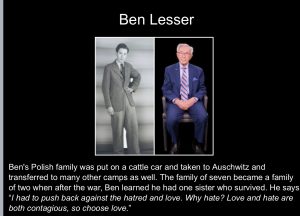 Ben Lesser (Nevada)
Ben was just nine years old when he was robbed and forced to grow up quickly. He was sent to four concentration camps and endured profound trauma. His story speaks to the power of survival and the importance of remembering.
“I learned that even through all the horrible things that were going on, you have to keep pursuing what is good in the world,” said Elin, who studied Ben’s story.
Addison noted that although their Zoom meeting hadn’t yet occurred, reading Ben’s memoir and using an AI tool to ask questions made his story come alive.
“Definitely sharing the stories… is how we can prevent something like this from ever happening again,” she said.
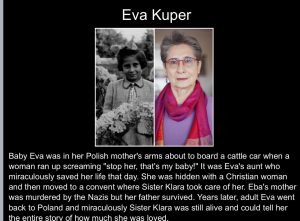 Eva Kuper (Canada)
Eva was deported to the Warsaw Ghetto as a child. Her mother was taken to a concentration camp and died. Eva was rescued by her father and a children’s book author and survived—a powerful story of tragedy and heroism.
“She had to go through this at such a young age,” one student said. “She had to be transferred around a lot. That takes so much bravery.”
Another added, “It shows how someone can take over your life and change it immediately. We need to realize it’s happening and stop it before it gets bad.”
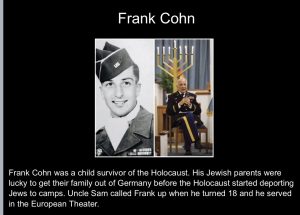 Frank Cohn (Virginia)
Frank Cohn fled Germany after Hitler’s rise to power and later became a U.S. Army officer. His early life reveals the fear Jewish families felt in the buildup to the Holocaust—and the courage it took to leave.
“You don’t notice how bad it was until you hear it from someone who experienced it,” said Laney.
“So many people don’t know these stories,” added Nina. “More people need to.”
“They shouldn’t have had to go through any of that,” another student said simply.
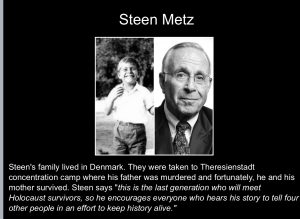 Steen Metz (Chicago)
At just eight years old, Steen Metz was sent to the Theresienstadt concentration camp in Denmark. Out of 15,000 children who were imprisoned there, only 1,500 survived. Steen was one of them.
“It was really heroic that he survived,” said Tayo.
“Out of 15,000 children, only 1,500 survived. That’s unbelievable,” added Charlie.
Olivia Fryermuth shared that it was nerve-wracking to speak with a survivor for the first time. “But he told us that’s why he shares it—so people don’t forget.”
Why It Matters
Lopez says the project has left a lasting impression on her students—and herself.
“They learned what it really was like through firsthand accounts,” she said. “And we won’t have access to those firsthand stories for much longer. I think this will stay with them for life.”
Students will now publish a class anthology of reflections and responses to ensure the lessons learned are shared beyond the classroom. For many, the takeaway was not just about history—but about humanity.
“These people were just kids like us,” one student said. “That’s what really hit me. It could have been any of us.”